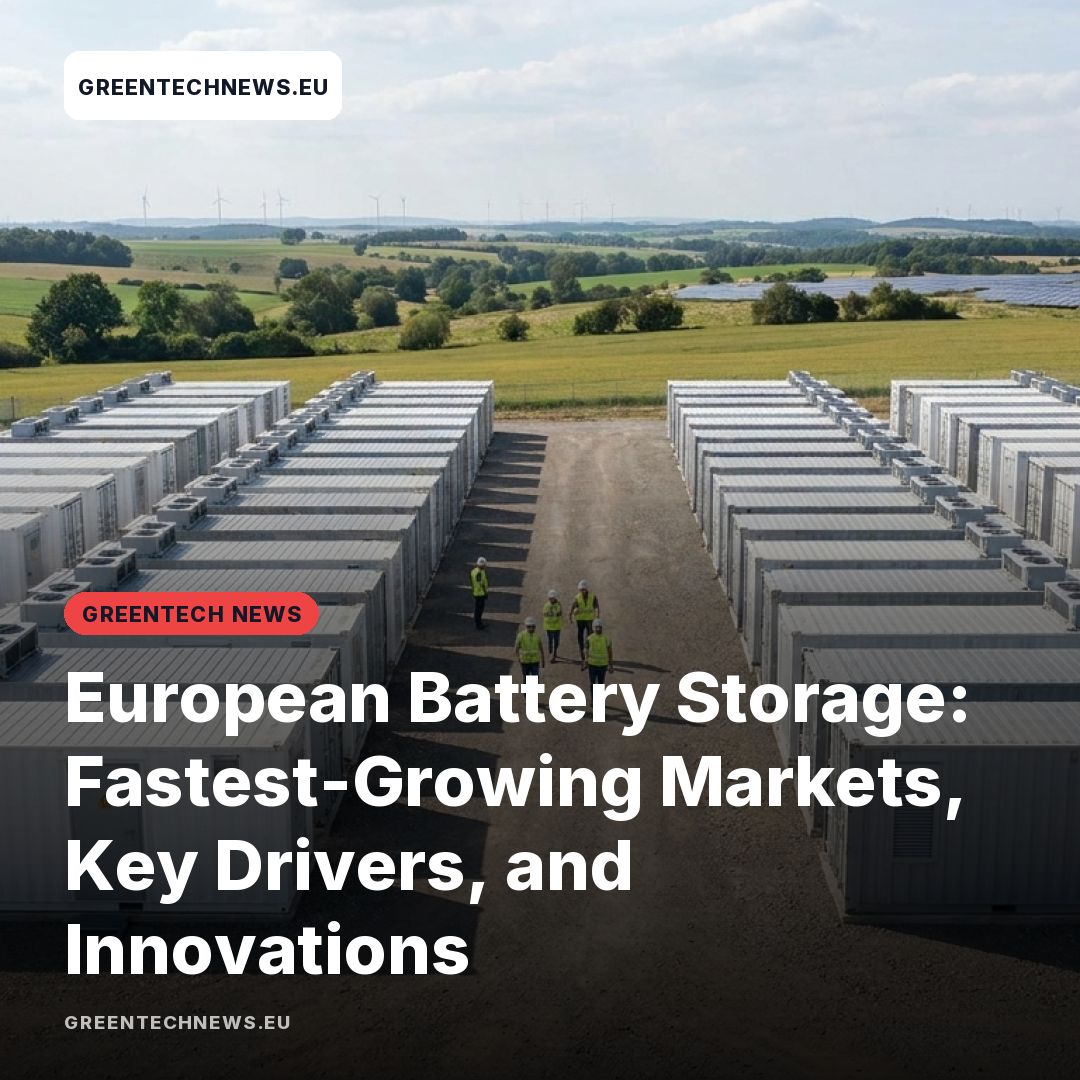
Germany, Italy, and Bulgaria are scaling battery storage most rapidly in Europe, driven by robust policy support and expanding utility-scale projects. The EU installed a record 27.1 GWh of new capacity in 2025, with innovations and strong local incentives accelerating deployment across several key markets.
European battery storage projects are scaling at record speed, with Germany, Italy, and Bulgaria emerging as leading markets thanks to policy support and robust investments. In 2025, the European Union installed 27.1 GWh of new battery energy storage systems, solidifying this technology as the fastest-growing clean energy segment in the region and setting a new benchmark for yearly expansion [1]. Understanding which countries are leading, the factors driving deployment, and the technical and regulatory innovations shaping the sector is critical for investors, developers, and policymakers seeking to leverage Europe's storage revolution.
- Germany, Italy, and Bulgaria are the top markets for battery storage expansion in the EU.
- Utility-scale projects now dominate new deployments, driving market growth.
- EU battery storage is projected to reach 57 GWh in 2026, indicating rapid sector momentum.
What Is Battery Energy Storage and Why Is It Central to Europe’s Energy Shift?
Battery energy storage systems (BESS) are devices that store electricity—primarily from renewable sources like wind and solar—for later use. These systems provide crucial grid balancing, supply flexibility, and enable deep integration of variable renewables. Unlike pumped hydro, BESS are rapidly deployable and highly scalable, making them essential to Europe’s decarbonization goals. With the EU’s ambitious renewable targets, battery storage is becoming a cornerstone of energy system stability and a key enabler of the green transition.
Where Are Battery Storage Projects Scaling Fastest in Europe?
The EU battery storage market achieved an unprecedented 27.1 GWh of new installations in 2025, marking its twelfth consecutive year of record-breaking growth and confirming BESS as Europe’s fastest-expanding clean technology [1]. Germany and Italy continue to lead the region in installed capacity, driven by mature policy frameworks, broad installer networks, and high renewables penetration. Crucially, Bulgaria has rapidly ascended to third place, showcasing how targeted incentives and EU recovery programs can help emerging markets leapfrog in adoption [1]. The Netherlands and Spain round out the top five, together accounting for 63% of all EU battery storage installations in 2025 [1].


Market forecasts project a 78% year-on-year increase to 57 GWh by 2026, with Germany, Bulgaria, Italy, the United Kingdom, and Spain expected to contribute the most new capacity [2]. This expansion is reinforced by both mature economies and agile emerging markets—underscoring the pan-European nature of storage scaling.
Which Factors and Policies Are Driving Deployment?
Several interlocking factors are propelling Europe’s battery storage market. Policy frameworks—such as capacity remuneration mechanisms, flexibility markets, and strong subsidy programs—have enabled the emergence of large-scale projects, particularly in Germany and Italy [2]. Bulgaria’s rise is closely linked to EU recovery funding and targeted incentives designed for rapid rollout. In all leading markets, electricity market reform and clear grid connection processes further accelerate deployment.
Market structure has also shifted decisively. Whereas previous years saw dominance by residential and commercial installations, 2025 marked a structural pivot: utility-scale deployments now drive the majority of new additions [3]. Economies of scale in procurement and construction, robust investor interest, and the evolution of grid services have all contributed to this transformation.
How Much Battery Storage Has Europe Deployed, and What’s Next?
By the end of 2025, Europe’s total operational battery storage capacity exceeded 100 GWh for the first time [3]. The continent also surpassed 100 GW of total installed energy storage across all technologies, with battery systems comprising a rapidly rising share [4]. Behind-the-meter storage—deployed at homes and businesses—accounted for 30.2 GW, while front-of-the-meter systems (mainly grid-scale projects) reached 18.5 GW. Key contributing countries include Great Britain, Italy, Poland, Belgium, Spain, and Bulgaria [4].
In 2025, around 6.2 GW of new battery capacity was added in Europe, with the share of utility-scale installations more than doubling to 4.6 GW [5]. Projections indicate total deployment could hit 57 GWh in 2026, driven by a utility-scale pipeline of up to 13 GW—nearly 50% higher than the previous year [2].
What Is Fueling the Shift Toward Utility-Scale Storage?
The surge in utility-scale projects stems from a combination of technical, economic, and regulatory factors. More mature electricity markets like Germany and Great Britain have introduced mechanisms that reward grid services, such as frequency regulation and balancing reserve, creating strong business cases for large batteries. Meanwhile, falling capital costs, supply chain maturation, and favorable permitting regimes are making multimegawatt batteries attractive for large asset owners. Policy-driven revenue stacking—combining arbitrage, grid services, and capacity payments—is accelerating returns on investment and facilitating project finance.
How Are Behind-the-Meter and Distributed Storage Markets Evolving?
While grid-scale projects are taking the lead in new deployment, the behind-the-meter market continues to deepen across several European countries. Germany, Italy, and the Netherlands, alongside Austria and Great Britain, are prominent markets for behind-the-meter and residential storage [4]. Here, growth is underpinned by solar-plus-storage adoption, consumer uptake of dynamic tariffs, and increased electrification in buildings and vehicles. These factors drive flexibility and grid support at the distribution level, complementing the system-wide impact of utility-scale assets.
What Are the Key Innovations Accelerating Battery Storage?
Innovations in battery chemistries, digital EMS (energy management systems), and advanced controls are enhancing the performance and economic value of BESS. Battery providers are introducing systems designed for longer-duration storage and multipurpose applications, such as providing both renewable integration and grid inertia. Digitalization enables better forecasting, aggregation, and dispatch of distributed assets into flexibility markets. Such advances open new revenue streams and increase the value delivered by each unit of storage deployed.
Typical Challenges in Scaling European Battery Storage
Despite remarkable momentum, common barriers include grid connection delays, complex permitting procedures, and uncertainty in long-term revenue streams. Bottlenecks in component supply chains and local workforce availability can also slow project timelines, occasionally tempering short-term growth projections.
Current Trends and Recent Developments
2026 forecasts point to even more acceleration, with projected deployment reaching 57 GWh—signaling a further 78% jump within a single year [2]. Utility-scale projects are driving this surge, with a pipeline of 13 GW expected, almost 50% more capacity than added the previous year. Europe’s energy storage sector as a whole has now surpassed 100 GW in capacity, with expectations of adding another 153 GW / 485 GWh of electrochemical storage by 2030 [4]. This highlights the enormous momentum and long-term potential shaping Europe's clean energy economy.
Conclusion: Strategic Takeaways for Investors, Developers, and Policymakers
Europe’s battery storage sector is scaling at a historic pace, driven by a blend of mature markets, fast-rising new entrants, and robust policy frameworks. With Germany, Italy, and Bulgaria setting the pace, and utility-scale projects now at the forefront, the region’s storage ecosystem is transitioning into a mature, investment-ready market. As rapid innovation and policy momentum continue, stakeholders must focus on grid integration, market mechanisms, and new business models to fully realize the technology’s potential and sustain growth.
FAQ
Where are battery storage projects expanding fastest in Europe?
Germany, Italy, and Bulgaria are currently leading in battery storage deployment, due to strong policies and investment, with emerging support seen in the UK, Spain, and the Netherlands.
What is driving the shift toward utility-scale battery storage in Europe?
Utility-scale projects are favored by evolving electricity markets, financial incentives, economies of scale, and the growing need for grid integration of renewables and flexibility services.
How much new battery storage will Europe add in 2026?
Projections indicate deployment could reach 57 GWh in 2026, a 78% rise from the previous year, mainly driven by large-scale installations.
Which factors could limit battery storage growth?
Key challenges include slow grid connection processes, permitting delays, and capital investment hurdles, though policy support and innovation are helping to address these barriers.
Sources
[1] EU Battery Storage Market Review 2025 - SolarPower Europe (SolarPower Europe)
[2] Europe’s storage market to hit 57 GWh in 2026, says EUPD Research (pv magazine Global, 2026-09-08)
[3] New report: European battery storage surges in 2025 as utility‑scale drives next growth phase (SolarPower Europe)
[4] European Market Monitor on Energy Storage (LCP, 2026-06-22)
[5] Battery storage is scaling up and taking on a larger system role - IEA (International Energy Agency)