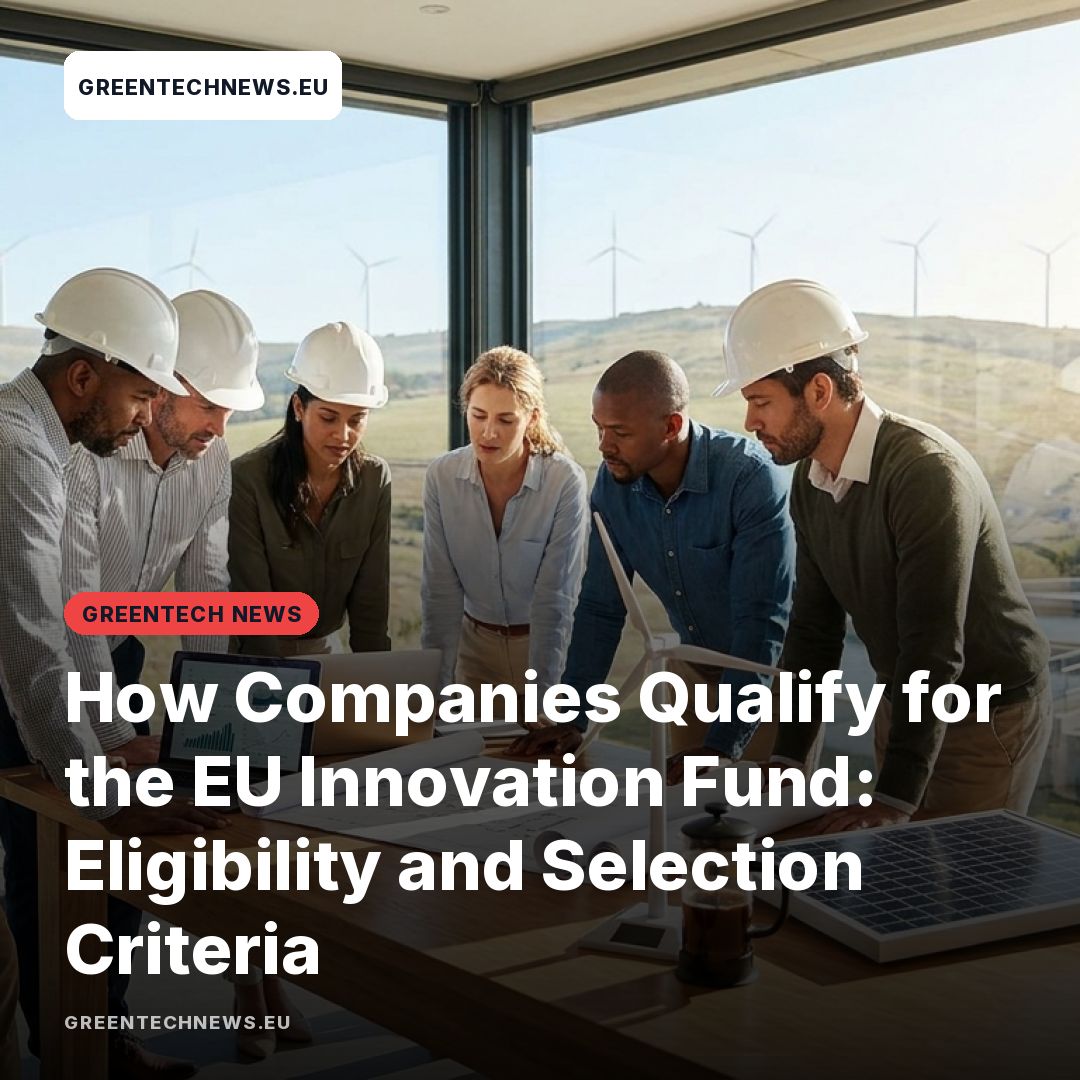
To qualify for the EU Innovation Fund, companies must lead innovative, mature climate projects based in eligible countries and meet strict selection criteria on emissions reduction, innovation, scalability, and cost efficiency. Each application requires robust technical, financial, and business documentation, with detailed rules depending on the specific funding call.
Companies seeking support from the EU Innovation Fund must ensure both their organisation and project are closely aligned with the Fund’s eligibility and award criteria. The Innovation Fund, managed by the European Commission, aims to catalyse climate-impactful projects and expects applicants to prove innovation, project maturity, and measurable emissions reduction. While some eligibility specifics and scoring rules vary by call, the key requirements for applicant status, project scope, and evaluation are consistent foundations for any company preparing a proposal.
- Applicants must lead innovative, sufficiently mature projects located in eligible countries.
- Grants prioritise greenhouse gas (GHG) avoidance, degree of innovation, scalability, and cost efficiency.
- Applicant eligibility, project requirements, and award criteria can differ by funding call and project size.
Who Can Apply to the EU Innovation Fund?
The EU Innovation Fund welcomes companies, public or private, and consortia aiming to demonstrate significant emissions reductions through first-of-a-kind, low-carbon projects in sectors such as energy-intensive industry, renewables, energy storage, and carbon capture, utilisation and storage (CCU/CCS)[1]. Both solo entities and groups of partners may apply; however, for consortia, a business must typically be the lead. NGOs and academic organisations are eligible as consortium members but not generally as principal beneficiaries.
Applicant companies must have a legal presence in an eligible country—most commonly EU Member States, Norway, or Iceland. Each call specifies if additional countries qualify. The core requirement is legal and financial capacity to execute the proposed project, including authority and relevant permits, and readiness to comply with all EU regulations and processes involved in the funding agreement.


Which Projects and Locations Are Eligible?
Eligible projects must offer direct contributions to greenhouse gas reductions and must be categorised as commercially relevant first-of-a-kind demonstrations—not mere research, but not yet established products or services at scale[1]. Supported sectors include renewable energy, heavy industry decarbonisation, CCU/CCS, and since recent calls, maritime and aviation[3]. The Fund distinguishes between project sizes: small-scale projects (total capital costs below €7.5 million) and large-scale initiatives (costs above this threshold)[1]. Some calls have also introduced medium-scale categories[3].
Projects must be implemented in one or more countries that are eligible as detailed in the call documentation, and substantially all activities must be carried out within those territories. Beginning with funding calls published as of December 2025, all projects must also adhere to the EU Taxonomy “Do No Significant Harm” (DNSH) principle. This requirement extends environmental safeguards beyond carbon metrics to ensure no adverse impacts on other sustainability factors, raising the bar for broad compliance[5].
What Project Maturity Must Applicants Demonstrate?
To stand a realistic chance, applicants must show their project is advanced beyond laboratory or pilot scale, yet not yet a commercially widespread product. Core maturity requirements span three axes: technical feasibility, business model robustness, and financial and legal structuring[1]. This means providing a developed technical concept (including technology readiness, site status, and identified risks), a clear operational map, and defined legal/financial arrangements for delivery and long-term viability.
Mature proposals demonstrate credible plans for reaching financial close within the period set by the call. Weaknesses such as missing site agreements, vague permitting status, or no track record of financing arrangements can undermine eligibility. Because of high documentation standards, many applicants rely on external expertise or Project Development Assistance before submitting their full application package[2].
How the EU Innovation Fund Evaluates Applications
The Innovation Fund evaluation begins with administrative and eligibility checks to ensure only admissible proposals move to expert review[6]. Projects are then scored by independent experts against specific award criteria:
Greenhouse gas (GHG) avoidance effectiveness: The project must demonstrate, with quantitative evidence, the emissions avoided compared to standard alternatives[1][3]. Well-documented baselines and clear avoidance calculations are crucial.
Degree of innovation: Applicants must evidence how their technology, operations, or business model are novel at commercial scale and not yet widely seen in Europe[1][3]. Substantiation with market context and benchmarks is required.
Project maturity: The technical, operational and financial details must show readiness for launch and implementation, including completion of permitting and key agreements[1].
Scalability or replicability: Applicants should explain how the solution can be adopted in other markets or by other operators, showing credible potential for replication or scale-up[1][3].
Cost efficiency: Projects are ranked not only by their emissions impact, but also by the funding requested per avoided tonne of CO2. Transparent, justifiable costs and a viable business model are expected[1][3].
If different proposals score equally, the Fund may prioritise those from underrepresented countries or strategic sectors[6]. Applicants can always find exact scoring matrices and procedures in the guidance documents for each call.
How Grant Calls Differ from Competitive Bidding
The Fund primarily uses regular grant calls, but also supports funding via competitive bidding (auction). Grant calls rely on detailed assessment according to the five award criteria, usually via a two-stage process for large-scale projects: expression of interest (emphasising emissions impact, innovation, and maturity), then a full application that covers all aspects[2]. Small-scale projects face a one-stage application procedure, occasionally with simplified criteria.
Competitive bidding calls, on the other hand, use strict eligibility screens before ranking qualified projects solely on the price applicants bid per tonne of avoided emissions in the auction. This process may favour companies with stronger upfront finances since all cost coverage and financial guarantees must be demonstrated, and 100% of eligible additional costs may be covered in the grant only after performance is proven[2][3].
How to Prepare a Competitive Application
Start by thoroughly reading the call documents to confirm applicant, sector, project type, and geographical eligibility. Build a robust baseline and emissions avoidance calculation and substantiate with evidence why your solution is novel compared to current alternatives. Prepare and document all technical, operational, financial, and legal plans, and demonstrate a plausible route to financial close and operational readiness. Business models and cost assumptions must be explicit and align with market benchmarks. Plans for future scaling or replication give extra credence, as do detailed assessments of project risks and mitigation strategies.
Ensure your proposal complies with DNSH and other specific environmental requirements, notably for calls published as of December 2025[5]. Given the range and complexity of required documentation, external advisors or Project Development Assistance can be invaluable for teams with limited in-house capacity[2].
Common Eligibility and Scoring Risks
Frequent pitfalls include falling short of required project maturity, especially for early-stage concepts or teams lacking a developed business model. Administrative complexity is high, particularly for large-scale, two-stage grants, requiring strong internal coordination and foresight. In competitive bidding, financial barriers can be formidable for small and medium-sized enterprises without robust balance sheets, given the demand for upfront cost coverage and guarantees[1][2][3]. In addition, from 2025, integrating DNSH environmental screening may introduce extra compliance hurdles, particularly for projects spanning multiple regulatory regimes within the EU[3].
Recent Updates and Current Developments
Since 2023, the Innovation Fund has expanded to cover sectors such as maritime and aviation, and introduced a medium-scale category to increase flexibility. Starting from calls published as of December 2025, project eligibility will be verified against the EU Taxonomy DNSH principle for environmental impact, setting a higher compliance threshold[3][5]. Successful projects now earn a STEP Seal, opening further opportunities for finance from other public sources after passing minimum scoring thresholds[6].
Practical Steps for Prospective Applicants
Prospective applicants should always begin with the most current call guidance, carefully confirming every requirement for both organisation and project. This means establishing a strong emissions baseline and verified avoidance methodology, clearly detailing innovation relative to the market, and providing proof of technical, legal, and financial maturity. Assign resources to collect documentation and, if needed, engage experts for complex or evolving requirements. Pre-screen for DNSH and other regulatory compliance, and clearly articulate every critical assumption and risk for reviewers.
Conclusion
The EU Innovation Fund offers major opportunities for climate-oriented innovation in Europe, but only for those able to meet demanding eligibility and selection conditions. Companies must show cutting-edge, mature projects with strong carbon abatement, present a clear case for replication or scale, and provide comprehensive technical and compliance documentation. By preparing thoroughly and seeking support when needed, businesses can maximise their odds of success and help drive Europe’s low-carbon transition through the Innovation Fund.
Sources
[1] What can be funded (CINEA – Innovation Fund) (CINEA / European Commission)
[2] Policy Background (CINEA – Innovation Fund) (CINEA / European Commission)
[3] What is the Innovation Fund? (European Commission Climate Action) (European Commission Climate Action)
[5] Innovation Fund Performance (European Commission) (European Commission, 2022-07-25)
[6] Assessment Criteria in EU Funding Evaluation (eur-lex) (EUR‑Lex (European Commission))