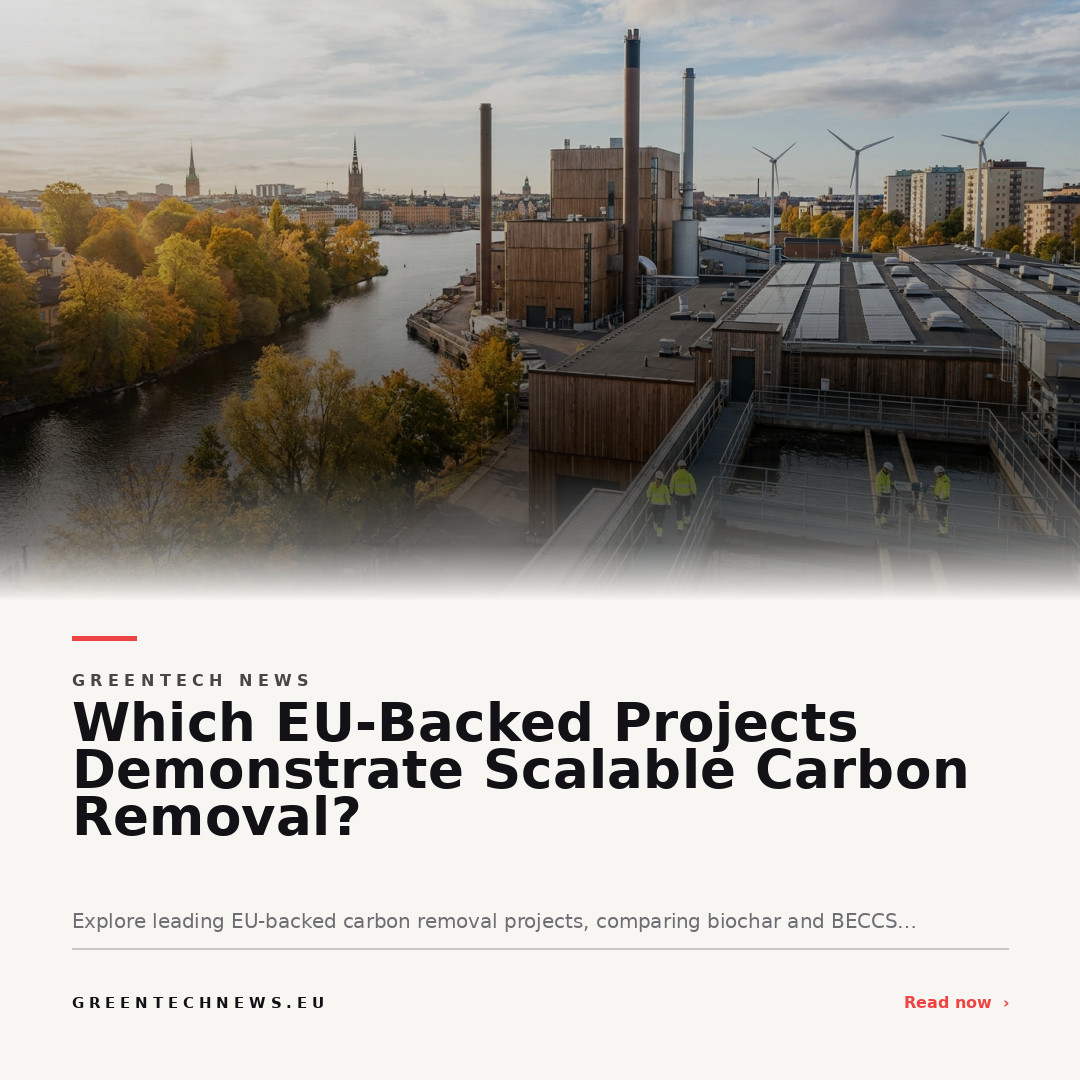
EU-backed projects like Stockholm Exergi's BECCS Stockholm and the Stockholm Biochar Project demonstrate how EU funding supports scalable carbon removal. While BECCS is designed to capture large volumes of biogenic CO₂ for geological storage, biochar initiatives focus on locking carbon in soil, with certification and monitoring central to replicability and trust.
EU-backed carbon removal projects are advancing scalable solutions to climate challenges by funding demonstrators such as the Stockholm Exergi BECCS Stockholm initiative and the Stockholm Biochar Project. These ventures harness bioenergy with carbon capture and storage (BECCS) and biochar production to remove carbon dioxide (CO₂) from the atmosphere. BECCS captures biogenic CO₂ from biomass-based energy and stores it geologically, while biochar stores carbon by integrating treated biomass into soils. Both are supported by the European Innovation Fund and feature robust EU certification frameworks, which are essential for commercial scalability across Europe.
- BECCS and biochar projects are leading EU-backed carbon removal pathways.
- EU funding and certification are key for scalability and market confidence.
- Demonstrated removal capacity differs from projected potential—performance data transparency matters.
What counts as scalable carbon removal?
Scalable carbon removal refers to permanent CO₂ sequestration methods that demonstrate the capacity to operate at large, replicable scales and maintain verifiable storage over decades or centuries. The European Union categorizes projects such as BECCS and biochar as viable when robust monitoring, reporting, and verification frameworks exist, supported by EU regulations like the Carbon Removal and Carbon Farming Regulation (CRCF). These frameworks ensure quantification, additionality, long-term storage, and sustainability are addressed in any carbon removal initiative[3].
The EU's pragmatic approach targets not just the technical feasibility but also the replicability—ensuring successful models in Sweden, for example, can inspire similar deployments in other member states. Scalability hinges on available infrastructure, biomass feedstock, policy incentives, and business model viability.
EU-backed project spotlight: Stockholm Exergi’s BECCS Stockholm
Stockholm Exergi’s BECCS Stockholm project stands as one of the most ambitious EU-supported carbon removal initiatives to date. Designed to capture and permanently store nearly 800,000 tonnes of biogenic CO₂ per year, the project has received approximately €180 million from the EU Innovation Fund. The plant integrates BECCS into an existing biomass-fired combined heat and power facility, using waste biomass as fuel and channeling CO₂ for permanent geological storage—a method classified as negative emissions technology.
A distinguishing feature is integration: the project leverages pre-existing urban energy infrastructure and district heating networks to optimize resource usage. However, critical to note is that this CO₂ capture capacity is a design target, not a reflection of operational results yet. Business readers should distinguish between anticipated capacity and independently verified annual removals, as future project stages will determine actual climate impact.
Biochar and BioCCS: how the pathways compare
Biochar carbon removal (BCR) and bioenergy with carbon capture and storage (BECCS or BioCCS) are both considered promising, but they serve distinct niches. BECCS primarily targets large-scale energy facilities where flue gas from biomass combustion is concentrated, allowing efficient CO₂ capture and deep geological storage. This pathway depends significantly on CO₂ transport networks and suitable geological formations for storage.
In contrast, biochar projects like the Stockholm Biochar Project, also backed by the EU, convert urban green waste into biochar through pyrolysis. The resulting biochar is then integrated into soils or materials, locking away carbon while providing agricultural or material benefits. The project’s integration in an urban context—supplying district heating while sequestering carbon—demonstrates how biochar production can advance both sustainability and circular economy goals. However, measured biochar removals tend to be smaller in volume compared to BECCS targets, and fewer projects report comprehensive performance data at scale.
What EU funding and certification change
The European Innovation Fund and EIB climate financing have emerged as primary enablers for scaling such projects. EU grants do more than fund engineering: they provide market validation, attract external investors, and accelerate commercial deployment, especially for startups employing innovative capture and storage techniques. Correct certification and clear standards have a direct impact on carbon credit markets, buyer trust, and the willingness of project developers to invest in expansion.
EU-level certification, under evolving frameworks like the CRCF, defines how projects quantify removals, demonstrate additionality, and ensure permanence[3]. The first methodologies target biochar and BECCS, supporting business models built on reliable, auditable climate impact. However, absence of harmonized rules or slow development of standards can create uncertainty, slowing market growth and project replication.
Demonstrated capacity versus projected potential
For investors, customers, and policymakers, the difference between projected and demonstrated capacity is critical. Stockholm Exergi’s target capture of 800,000 tonnes is a future goal; actual performance depends on technical commissioning, stable feedstock supply, and regulatory approvals. Operational proof—verified annual CO₂ storage—remains the gold standard for credible climate impact and further funding rounds.
Biochar removal, while operational in Stockholm and other locations, typically registers lower annual removal volumes. Still, the demonstrated integration into city infrastructure and supply chains makes it a pioneer for urban carbon removal models. EU support also encourages continuous improvement in monitoring and reporting, supporting transparent accounting for climate impact.
What makes a project replicable across Europe?
Replicability depends on several interactive factors. For BECCS, the precondition is a combination of biomass-fired facilities, CO₂ transport and storage infrastructure, policy certainty for negative emissions, and supportive incentives. Urban integration, as seen in Stockholm’s biochar facility, raises questions about feedstock logistics, urban planning, and regulatory frameworks in other cities.
Scalability of both BECCS and biochar models in Europe is still constrained by certification clarity, access to investment, and long-term monitoring costs. EU pilot projects offer vital technical learning, but each business case must consider regional feedstock supply, permitting hurdles, and local policy alignment. Harmonized EU-wide standards and strong MRV systems are critical for building investor and customer confidence in future project rollouts[3].
Typical Problems
The most urgent issues include the lack of clear and harmonized EU-wide certification and monitoring standards, which hinders both scalability and investment attractiveness. Biochar and CCS projects also grapple with how to prove long-term carbon permanence and economic viability as they grow[3].
Recent Developments
EU-backed projects like Stockholm’s biochar initiative are expanding their influence. Policy support and new Innovation Fund calls are helping drive momentum for both urban and rural solutions, building practical examples for cities and regions across Europe.
Conclusion
EU-funded carbon removal projects in Stockholm and beyond illustrate the potential of BECCS and biochar pathways for scalable, verifiable climate impact. Their success relies on more than technology—it demands clear certification, robust funding mechanisms, and careful differentiation between announced potential and proven operational removal. For entrepreneurs and investors, attention to these fundamentals will determine which projects set the gold standard for Europe’s low-emission future.
Sources
[3] Carbon removal: what are the options for the EU? (European Parliament, EPRS, 2021-03-01)