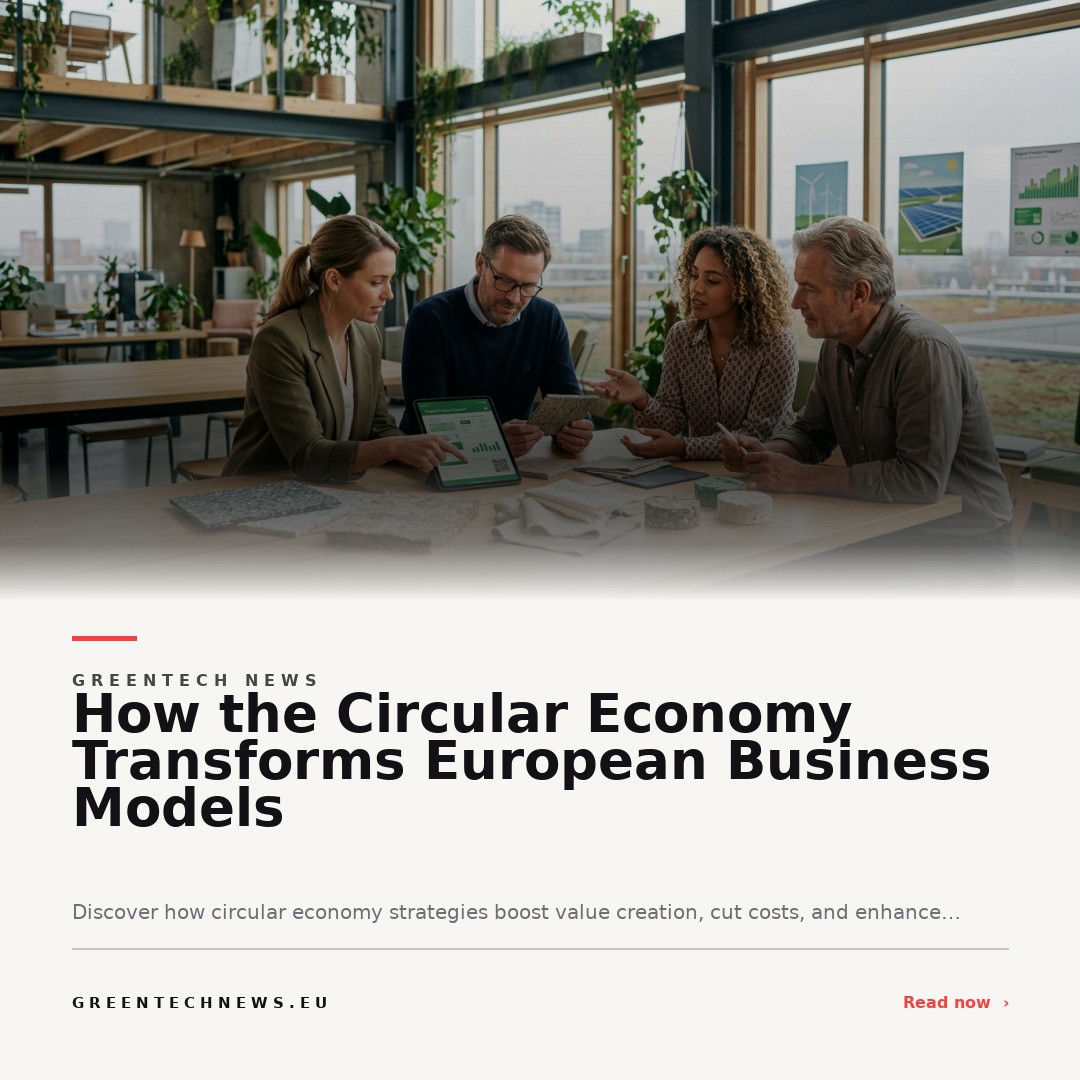
The circular economy redefines value creation for European businesses by promoting product longevity, reducing waste, and integrating circular models. Adopting these strategies leads to operational efficiencies and competitive advantages within the evolving EU market.
The circular economy is revolutionizing how European businesses approach value creation by replacing linear, resource-intensive models with systems focused on extending product lifecycles, minimizing waste, and fostering innovation. In 2026, companies seeking strategic and operational advantages across the continent are embedding circular principles at the heart of their business models, leveraging both regulatory pressure and shifting customer expectations to drive real change.
- The circular economy in Europe centers on extending product use and reducing waste.
- Business models include product-as-a-service, remanufacturing, and using recycled inputs.
- Regulations like the EU Circular Economy Action Plan push firms toward circular practices.
What is the circular economy and why does it matter for European businesses?
The circular economy is a systemic approach to economic development designed to benefit businesses, society, and the environment. Unlike the traditional 'take-make-dispose' model, the circular economy emphasizes extending product lifespans, reducing reliance on raw materials, and encouraging repair, reuse, and recycling. For European companies, this shift aligns with both growing regulatory requirements and increased consumer demand for sustainable choices, offering avenues to lower costs and achieve a resilient competitive edge over time.[1][2][3]
How does the circular economy redefine value creation for companies?
Value in a circular economy comes not from simply selling products, but from maximizing their utility through services, reuse, repair, and the integration of recycled materials. European firms are moving beyond basic recycling, creating platforms for sharing resources, developing refurbishing and remanufacturing services, and integrating circular inputs into manufacturing processes. This not only cuts waste but enables businesses to unlock new revenue streams, build stronger customer relationships, and differentiate themselves in increasingly crowded markets.[1][2][4]

What are practical models for circular business in Europe?
Circular business models thriving in Europe today include product-as-a-service, where companies retain ownership of products and customers pay for usage. Other models feature repair and refurbishment services, allowing items to be restored to full functionality, and remanufacturing, where old components are used to create new products. The sharing economy, through digital platforms, facilitates asset sharing between businesses and consumers. Additionally, the use of recycled materials as key manufacturing inputs reduces demand for virgin resources and aligns with regulatory expectations.[4]
How do EU policies and regulations drive circularity in business?
EU frameworks such as the Circular Economy Action Plan play a pivotal role, introducing requirements around eco-design, extended producer responsibility, and mandatory waste reduction standards. These policies are reshaping product development, supply chain management, and procurement across sectors, compelling companies of all sizes to incorporate circular thinking at every stage. Funding and support for innovation, such as for digital product passports and eco-design mandates, have been significantly increased to accelerate adoption.[3]
What benefits and business advantages arise from adopting circular models?
Companies adopting circular business models in Europe are achieving measurable reductions in material costs, improved risk management amidst resource volatility, and reputational benefits linked to sustainability credentials. Operational efficiencies emerge as products and materials remain in use for longer periods, reducing both input costs and waste management burdens. Critically, these models cater to changing consumer preferences for sustainable goods, driving market share growth and opening new business segments for forward-thinking firms.[1][2]
What typical problems do businesses face when implementing circular models?
Despite the compelling advantages, businesses often encounter significant hurdles when attempting to transition to circular operations. High upfront investments are required to redesign processes, invest in new technologies, and retrain employees. A lack of awareness, technical skill gaps, and the complexity of modifying established supply chains for circularity pose further challenges. Many companies also struggle to measure progress due to inconsistent metrics, making it hard to benchmark success or demonstrate value to stakeholders.[1][3]
How has recent EU policy evolved to accelerate the circular transition?
Recent European Union initiatives have expanded funding channels for circular innovation and imposed stricter requirements on product design and lifecycle tracking. Mandatory eco-design rules for priority sectors and digital product passports, now being rolled out in 2024, provide added impetus for businesses to track resources and improve recyclability from the outset. These regulatory updates are intended to ensure that circular economy principles not only coexist with, but drive business competitiveness and industrial renewal in Europe.[3]
What changes within organizations are key to successful circular transformation?
Moving to a circular business model goes beyond technical alterations, demanding a reconfiguration of organizational culture, stakeholder engagement, and value mapping. Adjustments to supply chains—particularly reverse logistics for collection and reprocessing—are critical, as is building new partnerships to enable product take-back, remanufacturing, and secondary markets. Internal change management must support new skill acquisition, encourage cross-functional collaboration, and shift strategic planning to prioritize resource efficiency over volume-based growth.[4]
How do customer expectations and innovation trends shape circular business opportunities?
Consumers across Europe are increasingly seeking products with verifiable sustainability credentials, prompting companies to innovate rapidly. Businesses that integrate circularity report greater demand for their offerings and are better positioned to adapt as environmental awareness grows. The ongoing trend toward transparency and measurable impact is expected to further drive innovation in service offerings, supply chain models, and circular value propositions.[2]
Conclusion: What is the outlook for circular business models in Europe?
For European professionals, founders, and investors, the shift to circular business models presents a rare combination of strategic necessity and innovative opportunity. The push from policy, markets, and technology converges to make circularity central to sustainable, resilient business growth. Continued advances—in metrics, digital infrastructure, and cross-sector collaboration—are poised to remove barriers, unlocking a new phase of value creation rooted in European circular principles.
Quellen
[1] The circular economy: Moving from theory to practice (McKinsey & Company, 2016-06-01)
[2] How to make the circular economy work for business (World Economic Forum, 2023-03-17)
[3] Circular economy in Europe: Developing the knowledge base (European Environment Agency)
[4] Innovative business models enable the circular economy in Europe (European Investment Bank, 2022-04-19)