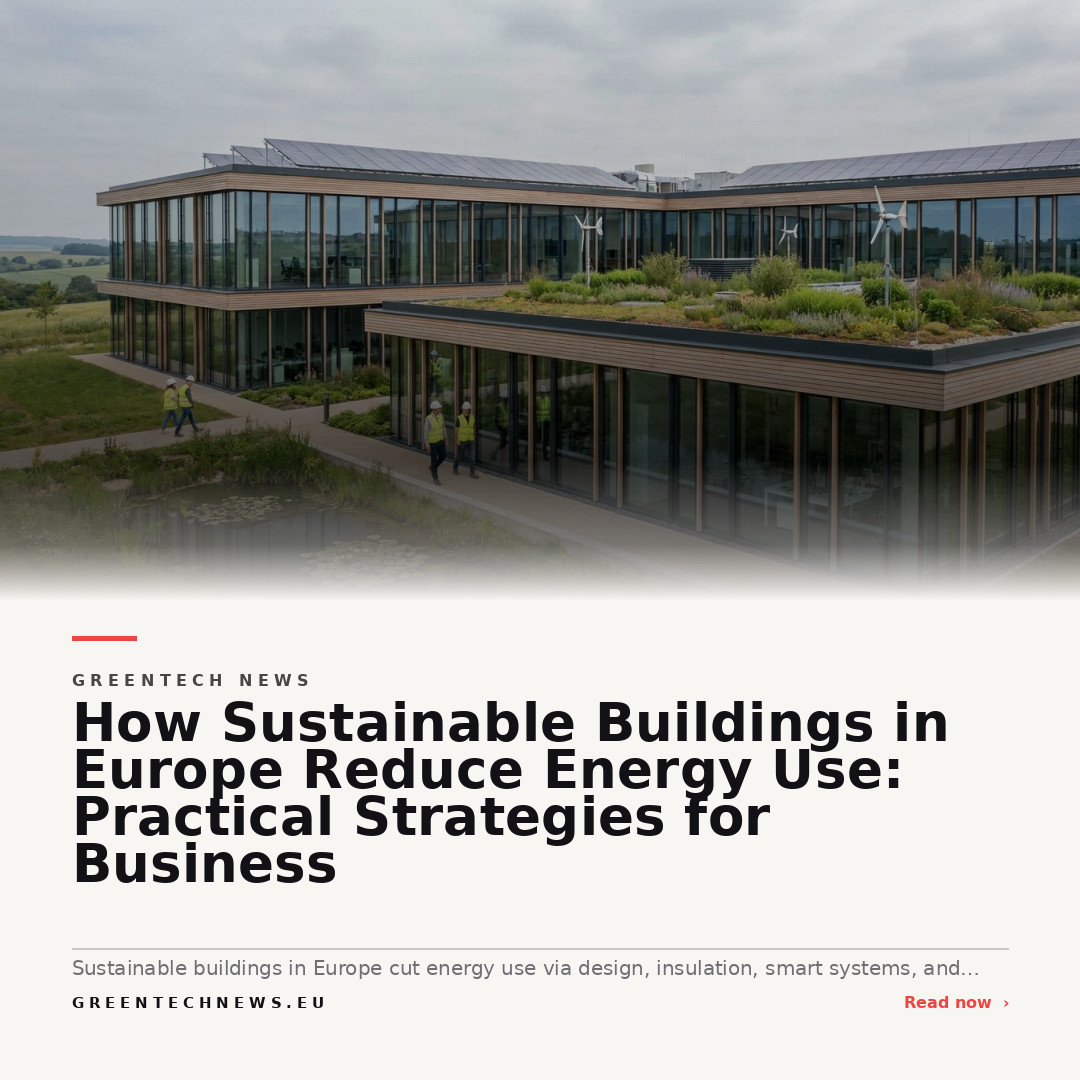
Sustainable buildings in Europe use advanced insulation, efficient systems, smart controls, and on-site renewables to significantly lower energy use. These measures, guided by EU policies, enhance building performance and reduce costs for owners and operators.
Sustainable buildings in Europe achieve substantial reductions in energy use by integrating high-performance design, efficient systems, and renewable energy, all under the framework of rigorous EU regulation. This approach not only lowers energy bills for building owners and operators but also increases asset value and ensures long-term compliance. By optimizing every aspect from the building envelope to operational controls, sustainable buildings become a strategic tool for businesses aiming to improve performance while contributing to climate targets.
- Envelope-first logic: Cutting demand through design and insulation makes all other measures more effective and cost-efficient.
- Smart controls and efficient systems address real-time demand, avoiding waste and aligning with business hours and occupancy.
- Renewable energy—especially solar and heat pumps—is integral for new and renovated buildings, meeting both legislation and investor expectations.
- EU policy sets the direction; national rules define project details, creating both obligations and funding opportunities.
Why building energy efficiency matters for European businesses
Building energy efficiency directly affects operational costs, regulatory risk, and the long-term value of real estate assets in Europe. According to the European Environment Agency, buildings account for about 40% of energy use and 36% of energy-related greenhouse-gas emissions in the EU. Improving energy performance is therefore a top priority for business owners, developers, and facility managers. Efficient buildings command lower running costs and are less exposed to energy price volatility, while also gaining access to green financing and eligibility for incentives tied to sustainability criteria. Increasingly, building regulations and corporate sustainability frameworks require verifiable carbon and energy performance, making energy efficiency a business imperative, not just a compliance box.
Start with the building: orientation, shading, glazing and form
Optimizing a building’s form, orientation, and glazing is the foundation of energy-efficient design in Europe. Passive strategies—such as maximizing daylight with well-placed windows, orienting buildings to capture or block solar gains, and using shading elements—reduce reliance on mechanical heating and cooling. Triple-glazed windows and other advanced glazing options minimize unwanted heat loss and prevent overheating, directly lowering baseline energy demand before any technical systems are installed.
Insulation and airtightness: reducing heating and cooling demand
One of the most significant opportunities for energy savings lies in the building envelope: walls, roofs, floors, and windows. European sustainable buildings implement high-performance insulation and focus on airtight construction to keep conditioned air inside and block external temperature swings. Retrofitting by adding insulation and replacing windows significantly improves airtightness and thermal resistance, making old buildings approach the standards of new ones. The less energy a building loses, the less must be supplied—shrinking both costs and emissions.
Efficient HVAC: heat pumps, cooling and ventilation
The next layer centers on efficient heating, ventilation, and air conditioning (HVAC) systems. Heat pumps—which transfer rather than generate heat—are a primary technology in both new builds and renovations, often running on electricity generated onsite or from renewable sources. These systems deliver more useful heat per unit of energy than conventional boilers. Smart ventilation and cooling solutions, tailored by climate zone and usage type, further reduce operational energy use.
Heat recovery and smart controls: managing energy in operation
To sustain performance, European buildings increasingly rely on heat recovery systems that capture waste heat from ventilation or appliances and channel it back into heating fresh air or water. These systems can lower the need for new thermal energy inputs in both new and upgraded buildings. Meanwhile, digital building management platforms and smart controls use sensors and automation to adjust lighting, HVAC, and other equipment based on real-time occupancy and need, preventing energy waste and helping owners track actual performance against design intent.
Renewables and energy supply: solar, storage and district systems
Onsite renewable energy generation is rapidly becoming standard practice, particularly solar photovoltaic (PV) and solar thermal systems. These technologies help neutralize residual energy demand and support decarbonization goals. For buildings with larger energy needs, integration with district heating and cooling systems provides access to shared, often renewable-powered, infrastructure. The combination of heat pumps and renewables is crucial for meeting stricter EU requirements and future-proofing property against evolving compliance frameworks.
New construction versus retrofit: choosing a practical pathway
New European buildings are typically designed to high standards from the outset, with integrated passive and active strategies, whereas most existing stock requires retrofitting to close the performance gap. Renovation priorities include upgrading insulation, replacing leaky windows, and adding smart energy controls—all steps that may require significant investment but can be staged over time to limit disruption. Energy audits and scenario analysis are vital for owners to prioritize actions that provide the highest return and minimize operational downtime.
How to combine measures and measure building performance
For maximum impact, sustainable building strategies work best when layered: first, reducing energy demand through envelope and design measures; second, optimizing system efficiency; and finally, deploying renewables to cover the remaining needs. Performance is tracked via energy use intensity metrics and, in many cases, legally required Energy Performance Certificates (EPCs). Monitoring and verification, ideally via a building management system, ensure that design promises translate to real-world results.
EU policy context: EPBD and the move to zero-emission buildings
The European Union’s Energy Performance of Buildings Directive (EPBD), most recently updated in 2024, sets progressively tightening standards for both new construction and renovation, with the goal of achieving zero-emission buildings by set deadlines. New public buildings must comply from 2028, with all other new buildings following in 2030. While the directive provides the overall framework, specific thresholds—including applicable technical standards and financial support mechanisms—are defined at the national level within each EU member state. Owners and developers should factor upcoming requirements and deadlines into investment and project planning to avoid compliance risks and capture available incentives.
Typical Problems
One of the main challenges remains the technical and financial difficulty of deeply renovating older building stock in Europe. Upgrades to insulation and airtightness can be particularly complex in historic or structurally challenging buildings. Despite the availability of EU grants and policy incentives, up-front costs and project complexity can present significant hurdles for business owners considering major retrofit projects.
Recent Developments
The revised EPBD, effective from May 2024, requires member states to tighten their national building codes, adopt higher energy efficiency thresholds, and expand incentives for renewable integration. This regulatory momentum is driving a significant shift in construction and retrofit planning, making early compliance and strategic investment increasingly important for building owners and operators.