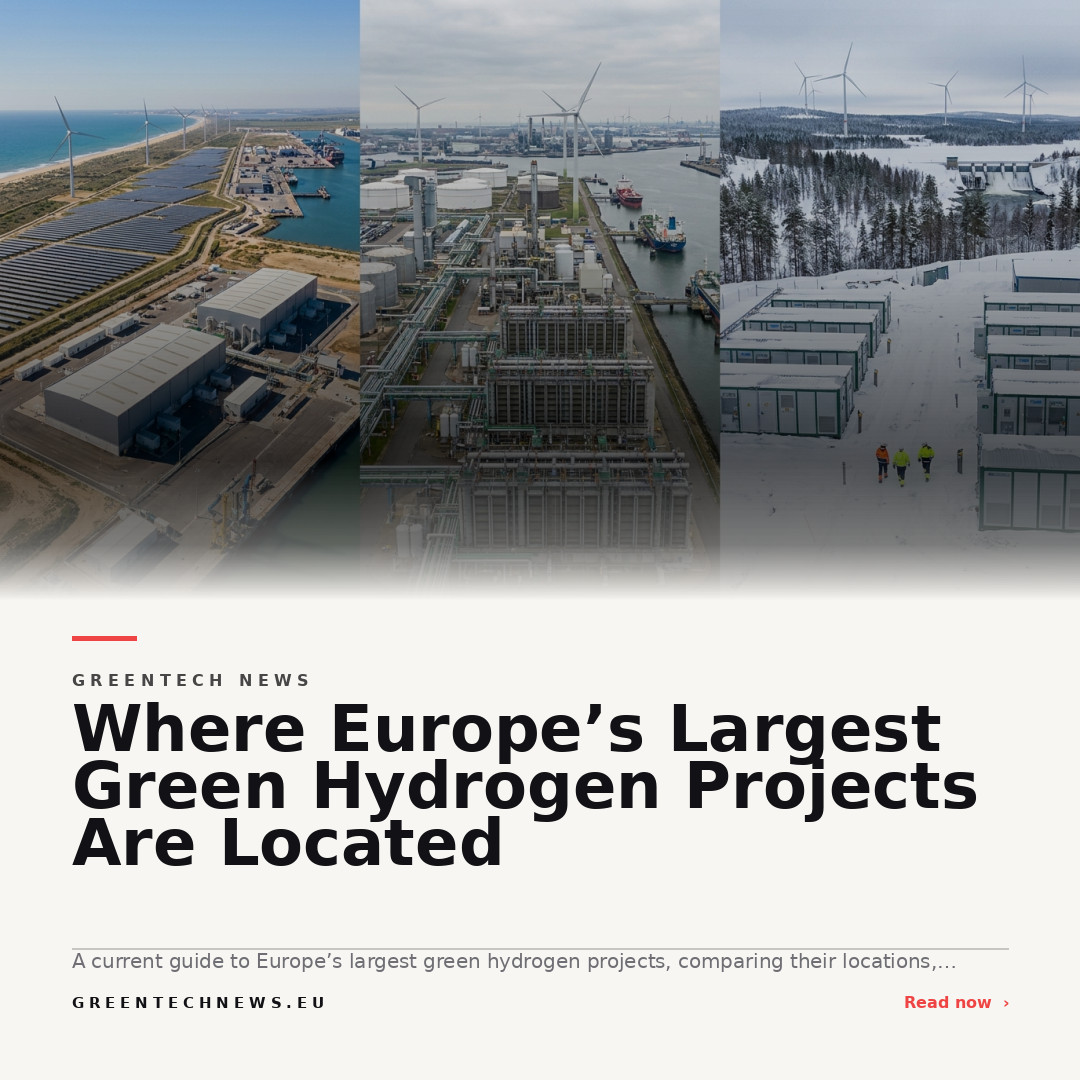
Europe’s largest green hydrogen projects are concentrated in regions like Huelva (Spain), Boden (Sweden), Rotterdam (Netherlands), and Lingen (Germany), each chosen for proximity to industry, ports and renewable power. These sites vary widely in electrolyser capacity, development status, and target sectors—most are under construction or approved, not yet operational.
Europe’s largest green hydrogen projects are situated in industrial and coastal hubs including Huelva in Spain, Boden in Sweden, Rotterdam in the Netherlands, and Lingen in Germany. These locations host multi-hundred-megawatt to gigawatt-scale electrolysers, selected for their access to renewable energy, ports, and heavy industry. The ranking of these projects depends on capacity (in megawatts, MW), expected annual hydrogen output (in tonnes), and their current status, ranging from operating pilots to under-construction and planned multi-phase ventures. This article offers a detailed map and status review of Europe’s largest green hydrogen projects, demystifying how such projects are compared and why leading developments cluster in these particular regions.
- Europe’s largest green hydrogen plants are mostly under construction or planned, not yet operational.
- Huelva, Boden, Rotterdam, and Lingen stand out due to location advantages: renewable energy, ports, and industry.
- Project size is defined by electrolyser capacity and expected hydrogen output; multi-phase projects are common.
- Industrial sectors such as steel, chemicals and refining are main users, shaping project locations.
How Are Europe's Largest Green Hydrogen Projects Ranked?
The scale of green hydrogen projects is typically measured by electrolyser capacity, often stated in megawatts (MW) or gigawatts (GW), annual hydrogen output, and project phase. Some projects announce headline figures for later stages but start smaller, so distinctions between current, under-construction, and future-planned capacity are critical. The largest projects by announced capacity are not always those delivering hydrogen today: few, if any, multi-hundred-MW plants are operational yet, with most leading developments still under construction or awaiting a final investment decision. For context, projects mentioned here are distinguished clearly by their development phase, capacity, and intended industrial usage.
Southern Europe: Huelva and Spain’s Hydrogen Valley
Spain’s Huelva region hosts the continent’s biggest approved project to date: the Onuba plant in Palos de la Frontera, part of the wider Andalusian Green Hydrogen Valley development. The Onuba plant’s first phase is expected to deliver 300MW electrolyser capacity, with the Catalina initiative across Huelva aiming for 2GW and targeting the annual production of approximately 111,000 tonnes of green hydrogen [1]. The project, granted final approval in late 2023, targets production in 2025, with plans to scale up over several stages. The Huelva cluster’s growth is powered by abundant solar and wind resources in Andalucía, access to deepwater ports for export, and a concentration of nearby refineries and chemical industries that can directly use the produced hydrogen. Policy support from both Spanish authorities and the wider EU reinforces the region’s appeal as a European hydrogen heavyweight.
Nordic Projects: Boden and Sweden’s Steel Transition
The Boden region in northern Sweden is the site of the H2 Green Steel project, which is closely linked to Sweden’s drive to decarbonize its steel industry. The project’s first phase is planned at 800MW of electrolyser capacity (with some sources listing initial deployments at 740MW), primarily for direct use in green steel manufacturing. Construction is underway. Boden stands out for its direct integration of green hydrogen with a new, low-carbon steel facility, setting a model for sector-coupled hydrogen ventures. The region’s access to very low-cost renewable hydropower and its focus on heavy industry position it as a leading green hydrogen hub in the Nordics. By tying hydrogen output to in-house steel production, the project maximizes offtake certainty and decarbonization impact—factors increasingly prioritized in both public policy and private investment decisions.
Northwestern Europe: Rotterdam, Lingen and Industrial Demand
Rotterdam, the Netherlands’ largest port city, is another cornerstone in Europe’s hydrogen map. The Holland Hydrogen I project, led by Shell, brings 200MW electrolyser capacity to the Maasvlakte industrial area, with commissioning due in 2027. This site is under construction, with expansion plans towards gigawatt levels as part of larger programmes such as NortH2, which aims for 4GW by 2030. Rotterdam’s position as a continental industrial and shipping hub, direct offshore wind connections, and its role in hydrogen imports make it an ideal testing ground for large-scale, integrated hydrogen production. Lingen in Germany, meanwhile, spotlights the GET H2 Nukleus project spearheaded by RWE, which is targeting 300MW commercial-scale electrolysers under phased construction—distinct from smaller, existing pilot facilities and closely coordinated with broader northwestern European hydrogen networks. The Refhyne II project at Lingen, rated at 100MW, also advances the region's hydrogen ambitions, focused on industrial offtake for chemicals and refining.
Other Major Green Hydrogen Projects in Europe
Beyond these hubs, notable ventures include the NortH2 project (Netherlands, targeting 4GW by 2030) and initiatives in the Port of Antwerp-Bruges (Belgium), which emphasizes supply chain infrastructure and import capacity for green hydrogen. These projects reinforce the trend towards port clustering and pan-European transport, with several forming the backbone of cross-border hydrogen corridors. Elsewhere, France’s Normand’Hy and ELYgator, among others, underline a pipeline of multi-hundred-MW proposals. The phase and certainty of these initiatives vary—while some are deep into permitting or early construction, many remain at the pre-investment stage. What unites Europe’s top projects is a focus on multi-user industrial clusters, port proximity, and high renewable generation for competitive green hydrogen output.
Why Are Major Hydrogen Projects Concentrated Around Ports, Renewables, and Industry?
The clustering of leading green hydrogen facilities around places like Huelva, Boden, Rotterdam, and Lingen is driven by three critical factors: first, heavy industry demand for low-carbon hydrogen (steel, refining, chemicals); second, ready access to plentiful, low-cost renewable electricity essential for electrolysis; and third, infrastructure advantages, including deepwater ports and established logistics for both export and import. National strategies—overlaying EU Green Deal incentives—add further momentum, with cross-border collaboration increasingly common to pool resources and balance supply with demand. The result is a North-South corridor of hydrogen production concentrated where infrastructure, policy and industrial needs overlap.
Operating, Under-Construction and Planned: What the Labels Mean
Most of Europe’s largest green hydrogen endeavors remain under construction or at the advanced planning stage, with true, fully operational gigawatt-scale facilities still several years away. Projects described here often proceed in phases: initial smaller deployments test technology and build offtake, before later expansion to headline gigawatt capacities. The difference between “approved,” “under construction,” and “pipeline/planned” is crucial for investors, policymakers, and suppliers to understand. Only a handful of multi-hundred-MW developments are currently in advanced construction as of late 2025; many others still face regulatory, financing, or technical barriers before shovels hit the ground. Phased execution reflects the emerging state of Europe’s hydrogen economy and evolving demand dynamics.
Typical Problems Facing Europe’s Green Hydrogen Projects
As these projects scale up, they face operational bottlenecks such as delays in grid connection, project financing uncertainties due to volatile energy prices, and a shifting patchwork of national and European regulations. The infrastructure needed to connect renewable power and distribute hydrogen lags behind ambitious capacity targets. Most gigawatt-scale ventures are still in early planning or permitting, with only a small number breaking ground so far.
Recent Developments and the Future Project Map
Key milestones have recently shaped the project map: Spain’s Catalina project, for instance, received its final go-ahead in late 2023—its anticipated 2025 start marks a shift from visions to real industrial production [1]. Early 2024 has brought new joint-venture announcements and European cluster agreements, designed to fast-track both infrastructure rollout and pan-European hydrogen networks. As project delivery accelerates, the European hydrogen landscape will be redefined. However, the transition from headline announcements to fully operational capacity will remain central to business strategy and policy scrutiny for years to come.
What Could Change the Project Map Next?
Europe’s green hydrogen map remains in flux, with future changes likely to stem from policy shifts, industrial decarbonization requirements, and new financing mechanisms. Cross-border hydrogen transport projects and aggregator business models could quickly transform both geography and market structure, especially if regulatory and permitting bottlenecks are addressed. The coming years will test whether these flagship projects deliver at scale—and what lessons they offer for Europe’s transition to a renewable hydrogen economy.
Sources
[1] Europe's Largest Green Hydrogen Project Progresses in Spain (H2 View, 2023-12-18)