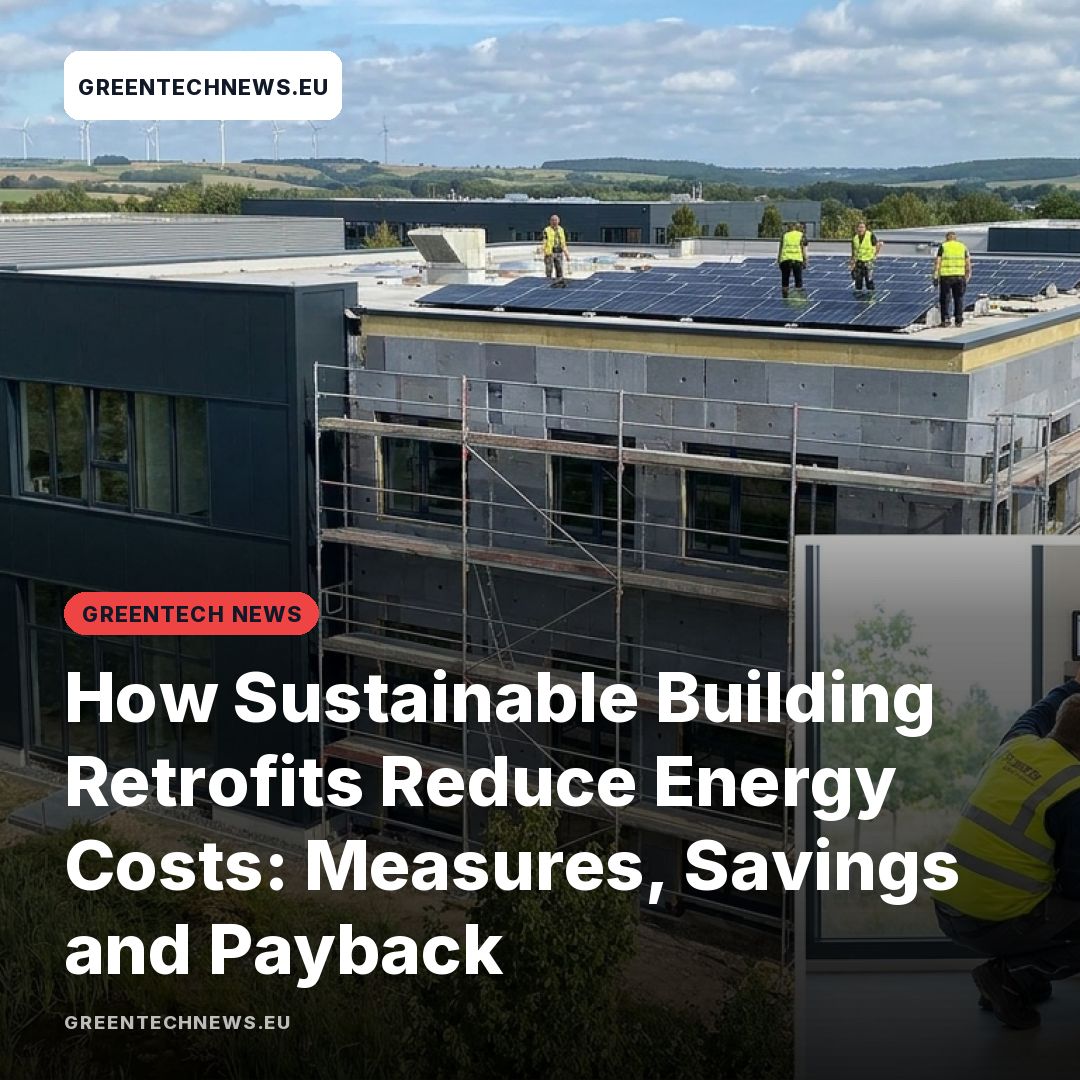
Sustainable building retrofits—such as improved insulation, efficient heating, smart controls, and on-site renewables—directly lower energy costs by reducing demand and optimizing systems. In Europe, realistic savings and payback periods depend on building type, baseline efficiency, and available financing, with smart controls often offering rapid returns.
Sustainable building retrofits—covering insulation, efficient HVAC, smart automation, and renewables—can cut energy costs dramatically for building owners and managers across Europe. By optimally combining these measures, businesses and residential property owners reduce energy waste, boost energy performance, and capture long-term value. In the European context, savings and payback depend on the building’s starting condition, climate, and the available public and private funding instruments.
- Insulation, modern heating/cooling, smart controls, and on-site renewables form the backbone of high-impact energy retrofits.
- Smart automation and controls often deliver fast and substantial energy-bill reductions, especially in commercial properties.
- EU funding, green loans, and tailored financing instruments significantly improve retrofit payback prospects.
How Do Sustainable Retrofits Lower Building Energy Costs?
Sustainable retrofits lower building energy costs by reducing energy demand and increasing system efficiency. Insulation decreases the need for heating and cooling by minimizing thermal losses; efficient HVAC systems convert energy into comfort with less waste; smart building controls optimize equipment usage to match occupancy and schedule; and on-site renewable generation offsets purchased energy. The effect is cumulative—each measure supports deeper savings, but results always depend on local climate, energy tariffs, and the building’s usage profile.
Which Retrofit Measures Deliver the Biggest Savings?
Retrofit measures yield different energy and cost reductions depending on their technical scope and the building’s baseline conditions. Improving the thermal envelope—like adding wall and roof insulation or replacing old windows—typically cuts heating and cooling needs by 20–30% in European climates, as shown in a major European study [6]. Upgrading to high-efficiency heat pumps and low-GWP chillers further reduces fuel and electricity use, especially when paired with smart system controls.

Smart building automation and control systems (BACS) can lower total energy consumption by up to 52% in offices and lecture halls, with payback periods around three years and an average investment of €28.7 per square meter. On-site renewable generation—mainly rooftop solar PV—reduces dependency on grid electricity and volatile prices, while further improvements arise when all systems work together.
How to Prioritise Upgrades for Your Building
The right order and combination of energy upgrades is best determined through a detailed audit of the existing building, including an assessment of current energy use, the building’s envelope, and installed systems. Owners should generally prioritize measures that address the building’s thermal shell first, followed by HVAC upgrades and automation, and only then add on-site renewables. This hierarchy ensures that renewables are sized for actual, lower demand and that investments are not wasted on oversized equipment.
In practice, deep retrofits that combine insulation, heat pumps, solar PV, and smart controls achieve the largest energy savings—over 80% in some residential projects—though payback periods can range widely, from about three years for automation to over 15 years for full envelope and renewable upgrades depending on specific site conditions and incentives [4].
How to Estimate Energy-Bill Savings and Payback
Estimating savings and payback for energy retrofits involves modeling pre- and post-upgrade consumption using real building data, local climate conditions, and projected energy prices. The simple payback period divides upfront investment by annual cost savings, providing a first benchmark; lifecycle cost assessment includes expected maintenance, replacements, and financing costs for a more complete financial picture.
For example, public building retrofits in southern Europe have shown energy consumption drops of more than 50%—lifting the energy performance certificate (EPC) rating from E to B, with a 15-year return on investment (ROI) of about 112%. Adding smart controls can further boost performance (e.g., upgrading EPC to class A), though higher initial investment tends to lengthen payback to well over a decade [5]. Building automation and control retrofits, however, typically show simple payback in just three years, making them particularly attractive where budgets are tight.
European Factors That Affect Retrofit Economics
Several local factors influence the economics of sustainable building retrofits in Europe, including climate zone, energy prices, the building’s size and usage pattern, and the prevailing energy codes. In colder regions or poorly insulated buildings, the savings from envelope and heating/cooling upgrades are larger. However, savings potential is highly variable for each building type and EU member state, since energy prices and available incentives differ widely. Accurate payback estimation must also consider additional project costs, ongoing maintenance, and the impact of relevant subsidies or tax credits.
Typical Problems
One common barrier for owners is the significant upfront capital required, especially for smart readiness upgrades, which can delay payback even when they improve comfort and performance [5]. Another issue is that public funding in the EU covers less than 20% of total renovation investments, meaning most projects require private capital, often through loans or performance contracts [3].
Recent Developments
To address funding barriers and accelerate renovations, the EU is expanding available financial instruments. This includes the Recovery and Resilience Facility, Cohesion Funds, the Social Climate Fund, and blended tools like ELENA, InvestEU, and LIFE CET, which aim to leverage private capital for large-scale retrofits [3]. Owners are thus encouraged to explore both public grants and tailored green lending solutions as part of their retrofit plan.
Financing Options for Building Renovations
European building owners can access a growing mix of renovation funding, including grants, subsidies, green loans, energy efficiency mortgages, energy performance contracts (EPCs), and blended public–private finance. The EU has allocated over €80 billion via the Recovery and Resilience Facility, plus €17 billion from Cohesion Policy Funds between 2021 and 2027, helping lower energy bills and unlock additional private investment [3]. However, owners must often combine these incentives with commercial loans or EPCs, where repayment is linked to realized energy cost savings.
Depending on the building’s function and investment scale, programs may target residential, public, or commercial properties, with eligibility and support levels varying significantly between countries and regions. Owners should consult local energy agencies and financial institutions for up-to-date offerings.
A Practical Retrofit Planning Checklist
To achieve cost-effective and sustainable energy savings, start with a professional energy audit to identify the building’s biggest inefficiencies and savings potential. Prioritize envelope and system upgrades that address the most significant sources of energy loss, and model both energy and financial impacts over the project’s expected lifetime. Seek qualified advice on available EU and national incentives, and compare offers for green loans or EPCs if public grants are insufficient. Finally, plan the timing of upgrades so that renewable systems are sized for lower post-renovation demand, which ensures the best long-term returns.
Sustainable retrofits for European buildings are increasingly viable as a financial investment—especially when sequenced and funded strategically. By leveraging automation, efficient systems, and targeted funding, building owners and professionals can sharply reduce operating costs, improve value, and contribute to climate goals.
Quellen
[3] Financing building renovations - Energy - European Commission (European Commission, 2026-03-09)
[4] Holistic energy-efficient retrofitting of residential buildings (HERB project) (CORDIS / European Commission, 2017-10-06)
[5] Smart readiness upgrades and economic assessment in existing public buildings: a case study from Greece (Springer Nature)
[6] Thermal envelope improvements and their impact (European Union (EPAHCONF2026))