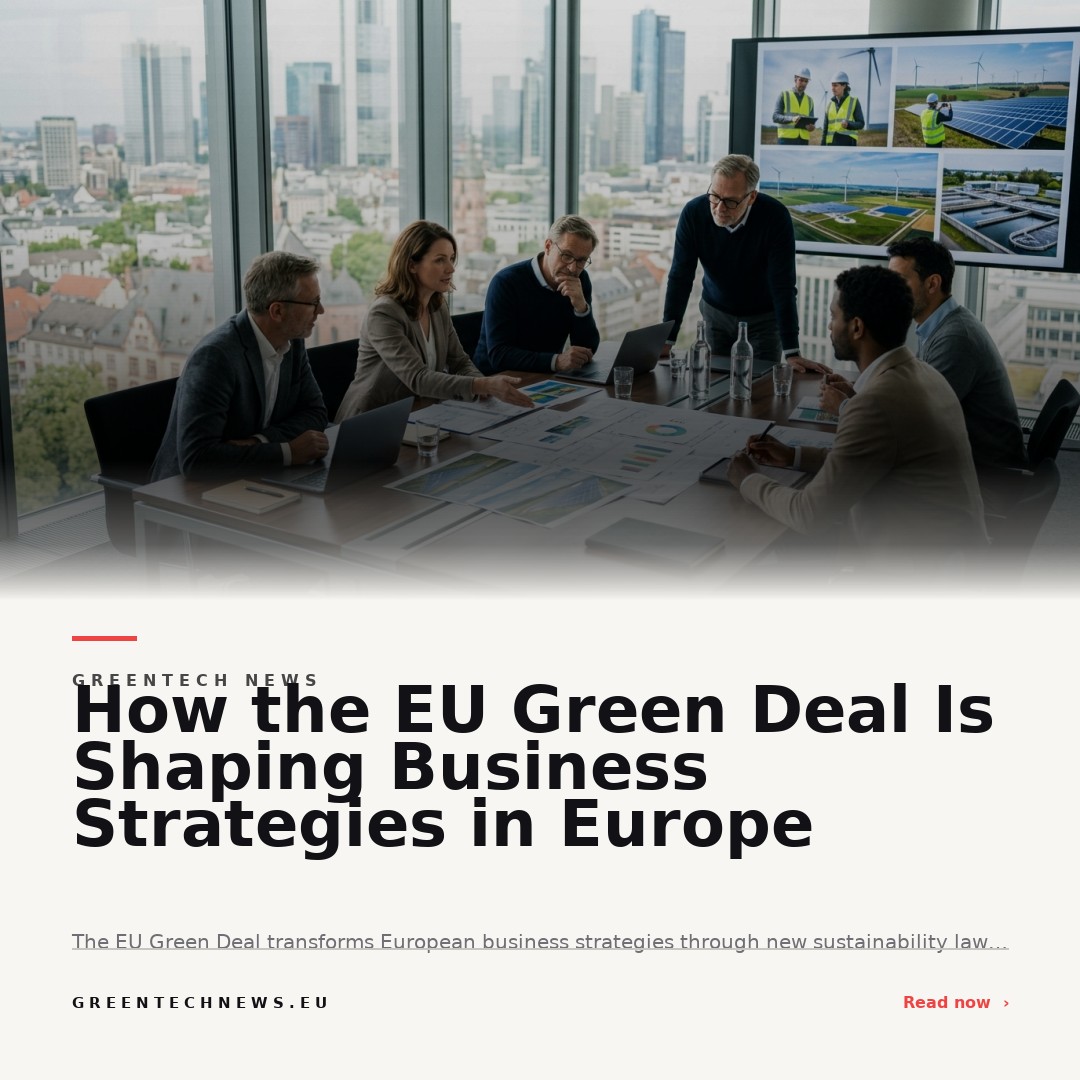
The EU Green Deal compels European businesses to cut emissions, improve sustainability, and adopt rigorous reporting, fundamentally altering business strategies. Companies face new compliance standards but also benefit from funding opportunities and a competitive edge through green innovation.
The European Union’s Green Deal is fundamentally changing how businesses in Europe approach strategy, compliance, and innovation. For companies across every sector, the Green Deal drives the urgent push to reduce carbon emissions, improve resource efficiency, and integrate robust sustainability reporting into core operations. Today, it is clear that aligning with the Green Deal is not just about meeting regulatory demands—it is a prerequisite for long-term competitiveness and market access within the EU’s economic landscape.
- The EU Green Deal requires businesses to drastically lower emissions, boost resource efficiency, and enhance sustainability reporting frameworks.
- New compliance obligations, particularly around ESG and circular economy, bring both complexity and opportunity.
- Businesses gain access to EU incentives and funding for innovative green projects—but risk penalties if they fail to adapt.
What is the EU Green Deal—and Why Does it Matter for Businesses?
The EU Green Deal is a sweeping set of legislative, financial, and policy measures unveiled by the European Commission to make Europe climate-neutral by 2050. It aims to decouple economic growth from resource use and environmental harm, positioning the EU at the forefront of global climate action. For businesses, the Green Deal is more than a policy statement—it entails a host of legally binding targets and standards. These include mandates to reduce carbon emissions, implement energy efficiency, adopt circular economy approaches, and increase transparency on environmental, social, and governance (ESG) performance as part of overarching corporate strategy across all industries [1]. Companies that regard the Green Deal as central to their mission, rather than a mere compliance issue, are likely to secure their place in the future EU market.
How Does the Green Deal Change Business Requirements in Europe?
Businesses now face stringent new requirements under the Green Deal. These span updated reporting obligations, notably through the Corporate Sustainability Reporting Directive (CSRD), and a growing range of sustainable finance regulations that affect how organizations disclose, measure, and improve their societal and environmental impact [3]. Companies must go beyond environmental compliance, with a legal obligation to report on ESG factors and to demonstrate active measures towards sustainability. Failing to meet these benchmarks may lead not only to regulatory penalties but also loss of business opportunities as the EU market pivots towards greener suppliers [5]. A significant aspect of these requirements relates to the supply chain: firms must now ensure that their entire value chain supports sustainability goals, prompting broad collaboration and reconfiguration of existing commercial relationships [2].

Opportunities: Funding, Innovation, and Competitive Advantage
While compliance brings complexity, the Green Deal also opens lucrative opportunities for European businesses. There is increased access to EU and national funding for renewable energy deployment, green innovation, energy efficiency upgrades, and circular economy business models [4]. Companies that align swiftly with the Green Deal position themselves to win public procurement contracts, attract sustainability-focused investors, and access special financing conditions. In addition, green innovation often confers a first-mover advantage in developing sustainable products and services, providing early entrants with a strong brand differentiation and expanded market share. Leading firms invest proactively in clean technologies, collaborative supply chains, and circular business models, using the Green Deal’s targets to drive long-term growth [2].
How Are Businesses Actually Adapting?
Across Europe, companies are reimagining infrastructure and processes: investing in energy efficiency, revamping logistics, and piloting new recycling or reuse programs. Many have begun integrating circular economy principles into their DNA, which means focusing on materials reuse, product longevity, and waste minimization. Partnerships between large corporations and smaller suppliers are essential, as responsibility for emissions and sustainability performance now stretches down the value chain. Adaptation also extends to financial operations, with sustainability increasingly central to risk assessment, investment decisions, and capital allocation. For businesses that view compliance as a checkbox, these changes pose a risk. Those that proactively embed sustainability gain competitive advantage through operational savings, resilience, and reputational strength [1][2].
Actionable Steps to Align Business Strategy with the EU Green Deal
To meet Green Deal obligations and harvest its opportunities, companies are advised to implement several core steps: conduct holistic assessments of their current environmental footprint, revise corporate governance to include ESG priorities, and establish clear targets for emissions reduction. Effective strategy involves cross-departmental collaboration to map out emissions along the supply chain, deploy energy- and resource-efficiency technologies, and establish transparent systems for sustainability reporting. Leadership commitment is critical, as is staff training on compliance and innovation. Engagement with stakeholders—including customers, suppliers, and regulators—helps ensure that transition measures are accepted and impactful [3][4].
Typical Problems Businesses Face with Green Deal Compliance
Despite these opportunities, practical challenges abound. Companies often struggle to update legacy operations, redesign supply chains, and mobilize the required investment for large-scale sustainability transitions [1]. For many, the cost and complexity of compliance—particularly for small and medium-sized enterprises (SMEs)—can be overwhelming. Difficulties include insufficient data for ESG reporting, technology gaps, limited expertise, and uncertainty around the evolving regulatory landscape [3]. There is an acute risk that SMEs, with limited resources, may lag behind larger companies unless support is improved or compliance frameworks better accommodate varying business sizes.
Current Developments and Regulatory Updates
The regulatory landscape continues to evolve rapidly. In recent months, the EU has provided critical updates on the technical standards of the CSRD, clarifying expectations for sustainability reporting for a wide spectrum of businesses. The expansion of the Carbon Border Adjustment Mechanism (CBAM) now directly impacts European importers, especially those reliant on carbon-intensive materials or products from non-EU countries [5]. These updates signal a steady tightening of requirements and highlight the importance of staying informed about ongoing changes, as non-compliance could quickly escalate into operational and financial risk.
Strategic Outlook: Turning Compliance into Long-Term Value
The EU Green Deal is more than a regulatory hurdle—it is a catalyst that compels European businesses to future-proof their operations against stricter environmental and transparency standards. By embedding sustainability deep into their core strategy, firms unlock innovation, efficiency savings, and broader stakeholder trust. Companies that anticipate regulatory trends and integrate environmental, social, and governance principles at strategy level will be best positioned to compete in the evolving European market and to lead in the emerging global green economy.
Quellen
[1] How the European Green Deal is influencing business strategy (Deloitte, 2023-08-10)
[2] How the EU Green Deal impacts business (World Economic Forum, 2023-07-31)
[3] How businesses can adapt to the EU Green Deal (PwC, 2023-04-15)
[4] The European Green Deal: What businesses need to know (Euronews, 2023-03-14)
[5] How does the European Green Deal affect businesses? (EY, 2023-06-12)