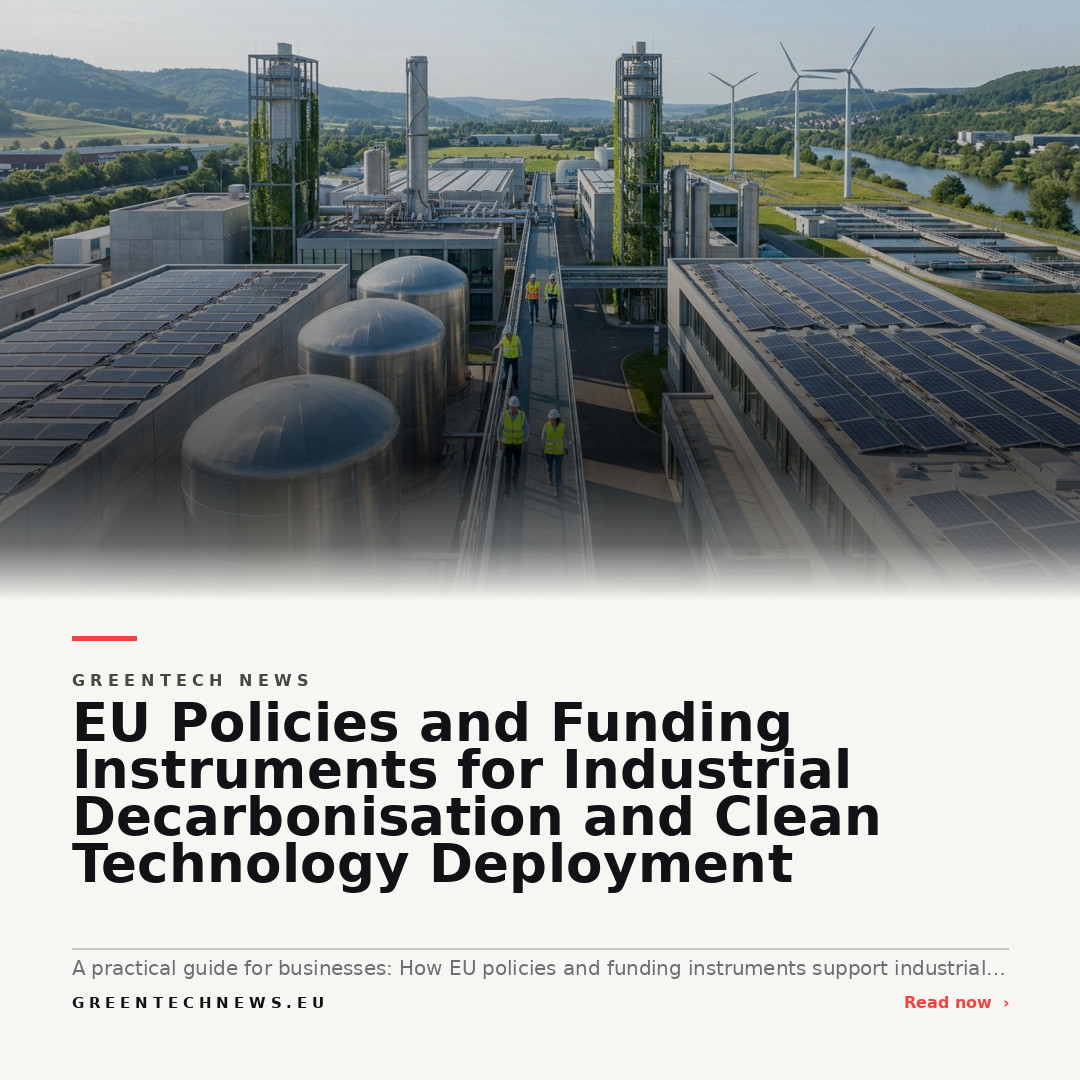
EU funding for industrial decarbonisation spans grants, guarantees, and state aid. Horizon Europe, the Innovation Fund, and InvestEU serve research, demonstration, and deployment phases, with state aid complementing large projects via national schemes. Selecting the right instrument depends on project maturity, financing need, and eligibility.
The European Union’s industrial decarbonisation strategy is driven by a suite of policy frameworks and funding instruments designed to enable businesses to scale up clean technology and transition towards climate neutrality by 2050. For companies seeking to deploy innovative low-carbon solutions or invest in green manufacturing, knowing which EU programmes offer support, how instruments differ, and how to identify the right fit for each project stage is critical. The core answer: the EU supports industrial decarbonisation through structured combinations of grants, direct financial support, investment guarantees, and state aid, each tailored to research, demonstration, or full-scale deployment needs.
- The Innovation Fund is a central tool for demonstrating low-carbon technologies in industry.
- Horizon Europe funds earlier-stage research and innovation.
- InvestEU mobilises public and private finance for scaling commercial clean tech projects.
- State aid rules allow direct grants, guarantees, and tax breaks under certain conditions, typically via national authorities.
Which EU policies shape industrial decarbonisation support?
EU industrial decarbonisation is structured around the Green Deal Industrial Plan, which boosts the competitiveness of Europe’s net-zero industry and aligns funding frameworks to deliver climate neutrality by 2050. The plan responds to international subsidy competition with streamlined permitting and more flexible state aid rules designed for rapid deployment of clean technology manufacturing and infrastructure. The Green Deal Industrial Plan also interfaces with key legislation such as the Net-Zero Industry Act (NZIA), which focuses on scaling up production of strategic clean technologies across the bloc. Overall, the policy vision integrates climate targets with funding, regulatory simplification, and state-supported scaling mechanisms to speed up the transition.
Which funding instruments are available?
The EU deploys a wide mix of funding and financial instruments tailored to different decarbonisation project types and maturity levels. The Innovation Fund is the flagship programme for demonstration and early adoption of innovative low-carbon technologies, targeting sectors like energy-intensive industries, advanced renewables, energy storage, and carbon capture, usage, and storage (CCUS).[2] For early-stage research and concept validation, Horizon Europe is the main grant programme. Scaling up to commercial market deployment is often supported by InvestEU, which aims to leverage both public and private capital, providing guarantees, loans, and other de-risking products suited to larger investments. State aid frameworks allow additional support to be channelled nationally under EU rules, ensuring compatibility while flexibly responding to local needs.


Match the instrument to your project stage and financing need
Each funding instrument serves a specific role in the lifecycle of industrial decarbonisation and clean technology projects. Early and mid-stage scientific and technical research is primarily supported through Horizon Europe and related R&D grants. When a technology reaches demonstration or first-of-a-kind commercial scale, the Innovation Fund provides significant support, often covering a substantial proportion of project costs and de-risking high-innovation deployments. For mature technologies needing market expansion, scaling, or replication, InvestEU and accompanying national co-investment provide access to finance through guarantees, loans, and equity, often mobilising additional private investment. National state aid, shaped by the EU Guidelines on Climate, Energy and Environmental Aid (CEEAG), can supplement these instruments with grants or tax incentives, subject to strict eligibility and transparency conditions.
How grants, guarantees, auctions and state aid differ
Grants are typically non-repayable funding, allocated via competitive calls for proposals under programmes like Horizon Europe and the Innovation Fund. Guarantees reduce the financial risk for investors or lenders, enabling projects with higher risk profiles to secure financing that might otherwise be inaccessible—this is the focus of the InvestEU programme. Auctions, increasingly used for renewables, allocate public support to projects offering the best value for decarbonisation output. State aid, which can take the form of direct grants, tax deductions, or guarantees, is managed at the Member State level under EU guidelines (such as the CEEAG), allowing countries to tailor support to their economy’s priorities while maintaining fair competition in the internal market.
Eligibility, application routes and co-funding
Eligibility criteria, application procedures, and co-funding requirements differ substantially among EU programmes. Horizon Europe and Innovation Fund calls are run directly by EU agencies, with transparent evaluation criteria and published application deadlines; project consortia are often needed. InvestEU requires engagement through participating financial institutions or, in some cases, via national promotional banks and agencies. State aid measures, while harmonised via EU rules, are administered locally—businesses apply through national governments or agencies, not directly to the EU. Many projects combine streams: for example, EU-level grants may cover part of the project while state aid supports the rest, provided combined support does not breach EU aid intensity limits.
How to build a funding strategy across EU and national programmes
Companies should map their project’s maturity, capital needs, technological risk level, and anticipated commercial returns against available instruments. Early-stage innovations generally begin with research grants before progressing to demonstration funding from the Innovation Fund. As commercial viability is proven, InvestEU or national investment banks step in to provide guarantees and scale-up finance. Co-funding is common, with national and regional schemes supplementing EU grants or guarantees. Given the complexity, professional consultancy or project development assistance may be necessary to navigate eligibility, optimise funding mix, and prepare robust applications.
Typische Probleme
A frequent challenge is the complexity of matching a project’s stage and risk profile to suitable EU funding instruments. Businesses often struggle with understanding eligibility requirements, coordinating between different schemes, and managing the administrative burden of applications—challenges that often necessitate specialist consultancy.
Aktuelle Entwicklungen
The Green Deal Industrial Plan recently introduced streamlined permitting and flexible state aid frameworks to accelerate support for clean technology manufacturing and deployment. These reforms come in response to international competitive pressures, including major US subsidies, and signal the EU’s intent to facilitate rapid scale-up of industrial decarbonisation projects with a more accessible and responsive funding landscape.
What businesses should monitor next
Funding programmes, calls, and eligibility criteria are subject to regular updates. Companies aiming for industrial decarbonisation projects should monitor the official portals of the Innovation Fund, InvestEU, and the European Commission, as well as national government websites for state aid opportunities. Additionally, businesses are advised to track new EU legislative developments, such as the implementation of the Net-Zero Industry Act and changes to the CEEAG, which may open new funding avenues or alter existing support mechanisms.
Quellen
[2] The Innovation Fund (European Commission)