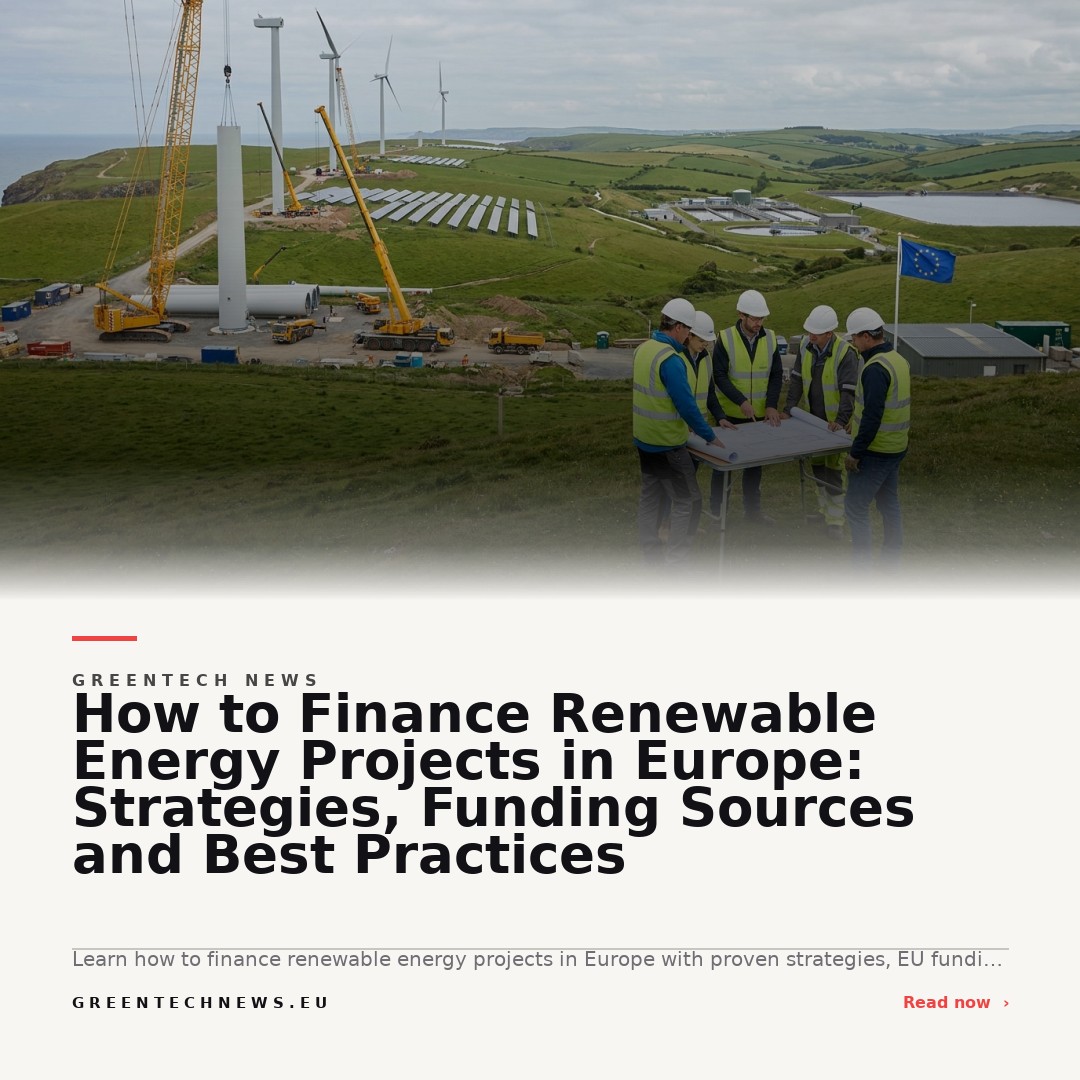
To finance renewable energy projects in Europe, use a mix of project finance, EU grants, loans, and private investment, tailored to project size and risk. Successful projects combine thorough risk assessment, stakeholder engagement, and the right funding mix, leveraging EU instruments and best practices.
Securing finance for renewable energy projects in Europe is a complex but achievable challenge when tackled with the right strategies, funding sources, and stakeholder engagement. As of September 2026, project developers, founders, and investors must navigate a growing set of financial instruments and best practices to ensure their ventures in solar, wind, and emerging green technologies reach bankability. The central approach is to align the project's structure and risk profile with suitable funding options, leveraging both EU-level and national resources for maximum impact.
- Key financing strategies: project finance, corporate finance, public-private partnerships
- Main funding sources: EU grants, national subsidies, green bonds, private investment
- Best practices: thorough risk assessment, stakeholder engagement, blended finance
What are the main strategies for financing renewable energy projects in Europe?
The most prevalent strategies for financing renewable energy projects in Europe are project finance, corporate finance, and public-private partnerships (PPPs). Project finance, widely used for large-scale ventures, involves structuring debt and equity so that repayment is drawn from the project’s future cash flows, not the parent company’s balance sheet. This offers both investors and developers the benefit of limiting risks to the project's assets, but it requires detailed financial modeling and strong contractual frameworks. Corporate finance structures, in contrast, use the balance sheet of an existing company or utility to raise capital, often suitable for larger, well-established energy players. PPPs leverage cooperation between public authorities and private entities, distributing both risks and returns to improve the project's attractiveness for a broader pool of stakeholders. Each approach must be carefully matched to the project's scale, technology, and risk appetite, ensuring alignment with long-term revenue expectations and regulatory certainty.[1]
What funding sources are available for European renewable energy projects?
Renewable energy developers in Europe can access a range of funding sources, each with distinct requirements and advantages. EU grants such as Horizon Europe and the Innovation Fund provide non-repayable contributions, focusing particularly on innovative technologies and cross-border collaboration. National subsidies and guaranteed feed-in tariffs remain important at member state level, though their availability and predictability vary between countries. The European Investment Bank (EIB), InvestEU, and the Connecting Europe Facility are critical EU financial instruments, offering low-cost loans and risk-sharing mechanisms designed to mobilize additional private capital.[3][1] Commercial bank loans and bonds, including green bonds, are frequently used for mature projects with proven technologies and stable cash flows. Equity finance comes from institutional investors like infrastructure funds, utilities, and increasingly private equity, who seek projects able to demonstrate long-term profitability and robust ESG (Environmental, Social and Governance) compliance. In recent years, crowdfunding platforms and energy cooperatives have empowered local communities and retail investors to back smaller-scale solar and wind installations, fostering public support and inclusivity.[5][3]


How can project developers structure financing for solar, wind, and other green technologies?
The structuring of renewable energy financing depends on the technology, scale, and risk profile. Solar photovoltaic (PV) and onshore wind projects, considered mature technologies, can often access debt financing at favorable rates due to perceived lower risk. Offshore wind, emerging hydrogen, and battery storage projects may require more sophisticated blended finance structures, combining grants, concessional loans, and private equity to offset early-stage or technology risks. The use of Power Purchase Agreements (PPAs) has become a central component in securing long-term revenue and attracting investment from institutional actors; a well-negotiated PPA can help mitigate price volatility and improve project bankability.[2] Developers often mix various funding streams—such as co-financing from public sources, equity from sponsors, and debt from banks—to spread risk and tap into available incentives. Technical assistance and advisory services—available through EIB and national agencies—play a substantial role in optimizing these structures and addressing gaps in financial expertise.
What are the best practices for successful renewable energy project financing?
Best practices for financing renewable energy projects start with a thorough risk assessment covering technological, regulatory, and market uncertainties. Clear stakeholder engagement—ensuring that local authorities, communities, and end-users are informed and involved—builds broad support and can ease challenges such as permitting or grid access. Leveraging blended finance, which means combining grants, concessional loans, and private funding, maximizes flexibility and resilience against market fluctuations. Today, applying ESG criteria is not just a recommendation but often a requirement for both EU funds and private financiers.[4] Making use of technical and legal advisory services where needed ensures compliance, enhances project credibility, and reduces transaction costs. In many cases, forming consortiums with trusted partners, including experienced contractors and financial backers, helps consolidate expertise and qualifies projects for larger sources of funding.
Typical Problems: What barriers complicate financing for renewables in Europe?
Despite the range of options, renewable energy project financing in Europe faces several persistent challenges. Regulatory uncertainty across EU member states—varying grid access policies, shifting subsidy regimes, and lengthy permitting processes—can deter investors and elevate perceived risks.[5] For smaller developers and community-led projects, difficulties accessing affordable finance are common. Lack of collateral, high transaction costs relative to project size, and limited financial know-how can result in exclusion from traditional funding channels.[4] These barriers slow the rate at which smaller or innovative projects can be brought to market and highlight the need for tailored financial support and guidance.
Current Developments: How are financing models evolving in 2026?
As of 2026, financing structures for renewable energy projects in Europe are becoming increasingly complex and sophisticated. There is a noticeable trend towards blending multiple funding sources within single projects, combining grants, commercial debt, green bonds, and equity to optimize for risk and return.[2] The EU has stepped up efforts to mainstream blended finance and risk-sharing facilities, particularly through the expanded scope of InvestEU and the EIB post-2020, with the goal of mobilizing additional private capital for large-scale renewables.[3] Another important trend is the focus on ESG compliance and inclusivity, as both public and private funding sources now require robust environmental and social impact assessments. Innovative instruments such as green securitisation and corporate PPAs are attracting new institutional investors previously hesitant to enter the sector.[2][4] Meanwhile, digital platforms and crowdfunding models continue to grow, enabling broad participation in community-level projects and making finance more accessible to grassroots developers.
What is the role of the EU and key institutions in facilitating renewable energy finance?
The EU plays a central role by creating the policy framework, providing funding instruments, and promoting best practices for renewable energy project finance across member states. The European Investment Bank (EIB) serves as the financial backbone for many large-scale initiatives, offering loans, risk-sharing programs, and technical assistance designed to improve project bankability.[1] The European Commission, through the Innovation Fund, Horizon Europe, and agencies such as CORDIS, issues targeted grants for innovative demonstrations and market replication projects.[3][5] These and other EU schemes often require project sponsors to demonstrate alignment with the European Green Deal objectives, effective contribution to carbon neutrality, and robust ESG credentials. National governments supplement with their own subsidies and guarantee schemes, aiming for policy coherence within the broader EU market. Collaboration with utilities, infrastructure funds, and private equity helps channel large volumes of capital into priority projects, fostering both scale and innovation in Europe’s clean energy sector.
Future outlook: What should founders, investors, and professionals focus on?
Looking ahead, professionals, founders, and investors should prioritize readiness for hybrid and blended financial models, with a special focus on ESG and sustainability factors that are increasingly central to due diligence processes. Staying informed about evolving EU funding instruments and national incentive programs increases chances of securing favorable terms. Given the ongoing regulatory and technological shifts, continuous investment in financial and technical skills, stakeholder engagement capabilities, and risk management frameworks will be essential. With strategic planning, leveraging both public and private resources, and commitment to best practices, renewable energy projects in Europe can achieve both bankability and significant climate impact in this decade and beyond.
See also
For more on building a career in European renewable energy project development, see How to Become a Renewable Energy Project Manager: Essential Skills, Steps and EU Career Pathways. For a broader perspective on startup funding opportunities, you may also be interested in Navigating EU Green Deal Funding: A Startup’s Guide to Greentech Opportunities.
Sources
[1] How to finance renewable energy projects in Europe (European Investment Bank, 2021-11-15)
[2] Renewable Energy Financing – How Does it Work? (Norton Rose Fulbright, 2023-01-25)
[3] Financing Europe’s energy transition: EU financing instruments and national support for clean energy (European Parliament Research Service, 2022-05-12)
[4] Renewable Energy in Europe: Financing challenges and recommendations for the future (International Energy Agency, 2023-06-10)
[5] Access to finance for renewable energy projects (European Commission (CORDIS), 2022-04-30)